You approach sustainability from two angles: one is more social, focusing on community housing, while the other is more technical and material-oriented, aimed at energy savings. How do these two perspectives complement each other?
We would like to achieve environmentally sustainable architecture and build without plastics, concrete, synthetic foams, and adhesives, by reusing materials or through renovations. However, we usually encounter financial limitations that prevent us from building the way we believe is right.
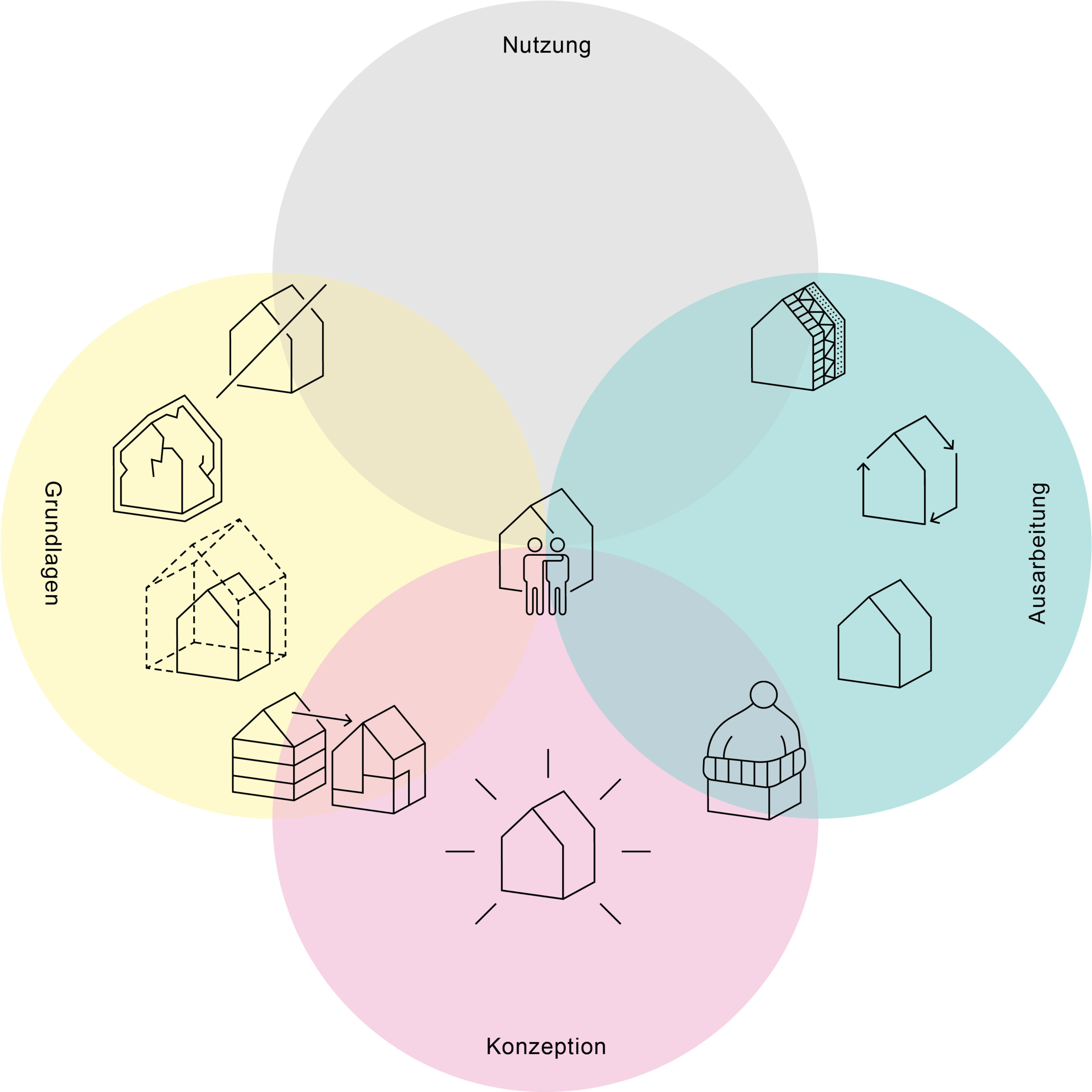
We have created a Manual for Building for the Public Good, a ten-point concept of how we want to build. The first point is not to build; the last is to build consciously. We also want to reuse entire buildings and materials, be energy-efficient, and build adaptively, simply, beautifully, and for people.
What do you see as the biggest advantages of community living?
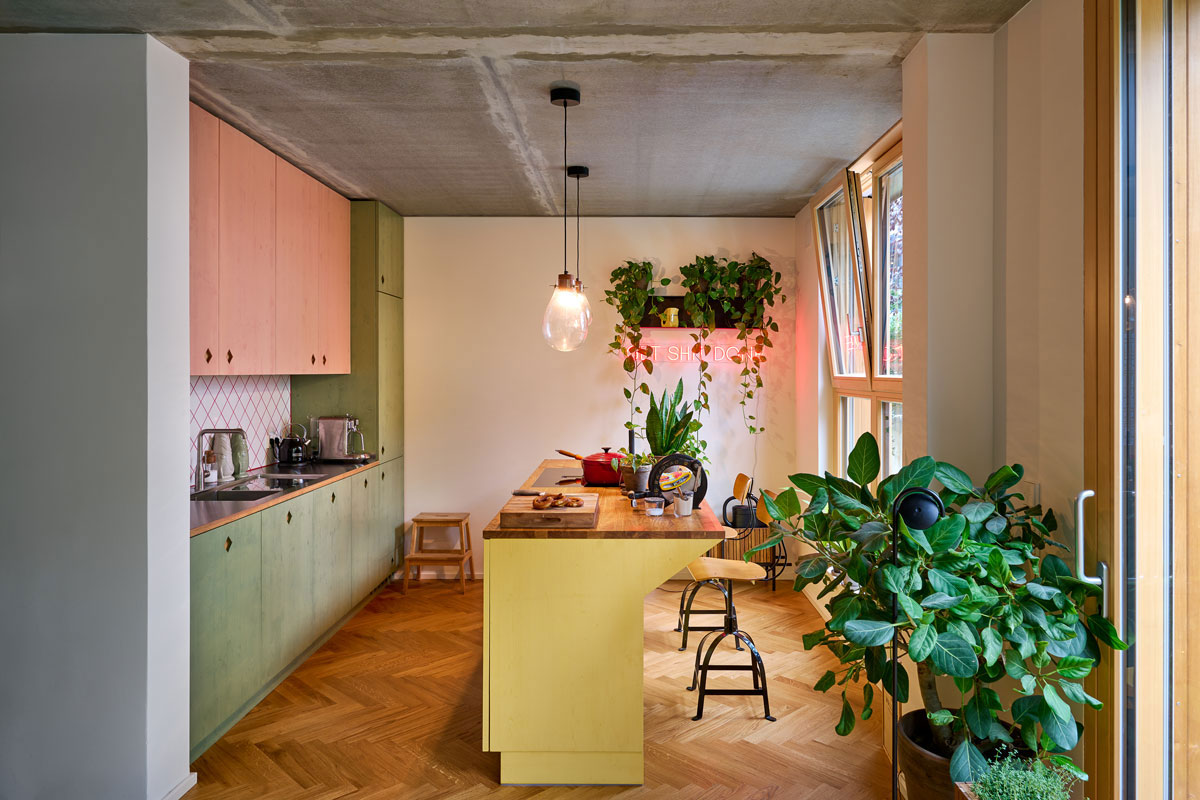
When more people come together, it creates the opportunity to build smarter. People don’t need their own home offices or guest rooms in their apartments. Anything that isn’t part of the private zone doesn’t have to be enclosed within the apartment. This allows you to have a small but high-quality apartment and great shared spaces.
We believe that every person needs twenty square meters of private space and four square meters of shared space. In a six-story building, this creates an entire floor for community spaces, which can include a coworking area, guest spaces, a children’s play area, a laundry room, or a café. Many people can’t imagine this right now, but if we build such projects, we’ll be able to show them a higher quality living space.
What is the tradition of community housing in Germany, and how has it developed?
Community housing currently exists in Germany, but it’s the thing of a certain group of people who are interested in this issue. In Berlin, so-called Baugruppen were popular fifteen years ago, when it was still possible to find affordable land in the city. Their advantage is that people build for themselves, expecting to spend most of their life in that house. That’s why they are usually strongly focused on quality, healthy living, and appropriate materials. Today, with rising prices, the situation is changing, and collaborative projects—housing cooperatives—are gaining popularity.
The difference between these models is that a Baugruppe transforms into a traditional home owners' association once construction is complete. As a result, cities are no longer willing to offer these groups discounted land prices, since each owner can sell their apartment on the open real estate market. This addresses the issue of affordable housing in the short term, but not in the long term. At the same time, given today’s prices and interest rates, it is relatively unrealistic for a group of people to get together to purchase land and build a house.
Housing Cooperatives, on the other hand, ensure long-term sustainable housing prices, which is why their numbers are growing. If you are part of such a project, you are essentially buying shares in it. You can finance these shares with a loan provided by a state-owned bank, making it more advantageous than a market-rate loan. This solution is currently more accessible. Another major advantage is that people do not own a specific apartment, but rather a share in the whole. If their situation changes and the apartment becomes too small or too large for them, they can swap apartments within this community.
Another thing we’re working on is connecting with someone who owns a really large number of apartments. Let’s say several hundred, because with that many, we can test the process of exchanging, modifying, or dividing apartments. Our idea is that if we reorganize, for example, five hundred apartments, we’ll end up with about a hundred left free.
Do people in Germany live in larger apartments than they actually need?
The size of apartments has increased significantly in recent decades. Back in the 1960s, it was 20 square meters per person; today it’s 54. That’s two and a half times more. On average, seniors live in 80 square meters. The situation is so inflexible that people prefer to stay in apartments that are no longer suitable for them in terms of size.
I think Germany has enough housing for everyone; we just need to create the conditions so that everyone can live in an apartment or house of a suitable size. We don’t need to build more; we need a more efficient system and housing price regulation.
People often think about housing in terms of their whole life, but it’s important to be more flexible over time. Homes are often built to meet the needs of a young family, but that’s only a short period of time; children soon move out, and people are then left with huge apartments they don’t use. That’s why we try to design houses or large apartments in such a way that they can be split up later. When children move out, it’s easy to add another kitchen and rent out part of the apartment as a separate unit. But such a change must be simple, without major construction work.
People lose nothing by living in a smaller space; on the contrary, they gain a lot. The kitchen and living room are what matter—that’s where life happens. Bedrooms can actually be tiny, and a child’s room doesn’t have to be huge either.
Community living takes many forms, from urban apartment buildings to rural projects. Which of these are you currently focusing on the most, and what advantages do you see in each type of project?
In cities, prices are a key factor. Real estate is expensive; people already live in small apartments and are looking for smart solutions to make the most of their space. That’s also the reason for collective building. In rural areas, we face different challenges, but the approach is the same: we need community-based building, to join forces and build better.
However, even rural projects are often initiated by people from cities. One example is Schöner Hof, where people who were fed up with the high cost of living in Berlin but wanted to stay close to the city came together. Berlin has become very expensive, but the surrounding region of Brandenburg is very affordable. Moving to the countryside is facilitated by good public transportation and the trend of remote working. Schöner Hof, located about an hour from Berlin, combines the benefits of suburban living with the atmosphere of an old farm. One advantage is the abundance of storage and communal spaces; the local children have even created a small museum using items found in the historic buildings. A major strength of this project is its welcoming and friendly community.
Werkdorf Billberge is also a cooperative project within easy reach of Berlin. Members are currently getting together, and we’ve noticed that many of them are in their 50s or 60s and are looking for a place to enjoy a high quality of life. As they near the end of their working lives, they want to leave the rush of the big city but still live in a pleasant community. The plots are located about an hour’s drive from Berlin, on the banks of the Elbe River heading toward Hamburg. It’s no problem to go into the city for cultural activities while still enjoying the quiet and nature of their home.
Rural community housing projects are also beneficial for small towns and villages that are currently facing depopulation. Abandoned town centres are emerging throughout Germany, which is why we have recently observed active interest in community projects from municipalities as well.

Your work isn’t just about architecture itself—what general ideas underlie it?
If we live in a smaller apartment, we spend a smaller portion of our income on housing, which means we can work less and have more time for what makes us happy. That’s what’s important, and what we want to focus on: making people happier and striving for a good life for everyone.
It’s a broader problem where everything is evaluated based on money earned, based on its contribution to GDP. But that says nothing about the actual benefit of a given activity to society, nor how it causes harm, nor how much it actually costs society as a whole. Even wars, diseases, and other negative phenomena increase GDP. That is why we are interested in the Economy for the Common Good, specifically tracking the Gross Happiness Product. This indicator actually measures how happy people are; in addition to financial contributions, it highlights what harms or benefits society. The only country that tracks this indicator is Bhutan.
Our company began measuring Gross Happiness Product for the first time in 2020, and it was a profound realization of who we really are. It’s not just about the architecture we produce, but also about the relationships we have with our employees and suppliers, how we collaborate, and where we invest. If every company were to do this, society could change for the better in many ways.
What we as a society should focus on is a happy life for everyone. It is something anchored in the constitutions of most countries around the world, but no one is actually working towards it. If this becomes our main focus again, we can start steering in a better direction. We have discovered that communism doesn’t work, and now we know that capitalism doesn’t work either, so we must find a new way to take the good things we know and create something new. That is our task for the coming decades; otherwise, we will destroy our planet, or we will destroy ourselves in some war. And what makes us strong is cooperation.
Even if we fail to change the whole world, we are already improving our little world to make it a more pleasant place to live. It is part of democracy; it is not just about voting once in a while—everyone can take many small steps to improve the situation. We can teach children to have an open view of the world, be part of non-profit organizations, and actively participate in civil society.
As an architectural company, for example, we strive to collaborate extensively with other studios, enriching one another and learning from each other. We also seek to communicate our philosophy and be authentic. Trust is important to us, as is being transparent and speaking openly about how we see the world.